Melt3D · Blog
Non-planar printing.
The 3D printing method that shifts and curves layers instead of stacking them flat, unlocking shapes standard printers can't reach.
Scroll to read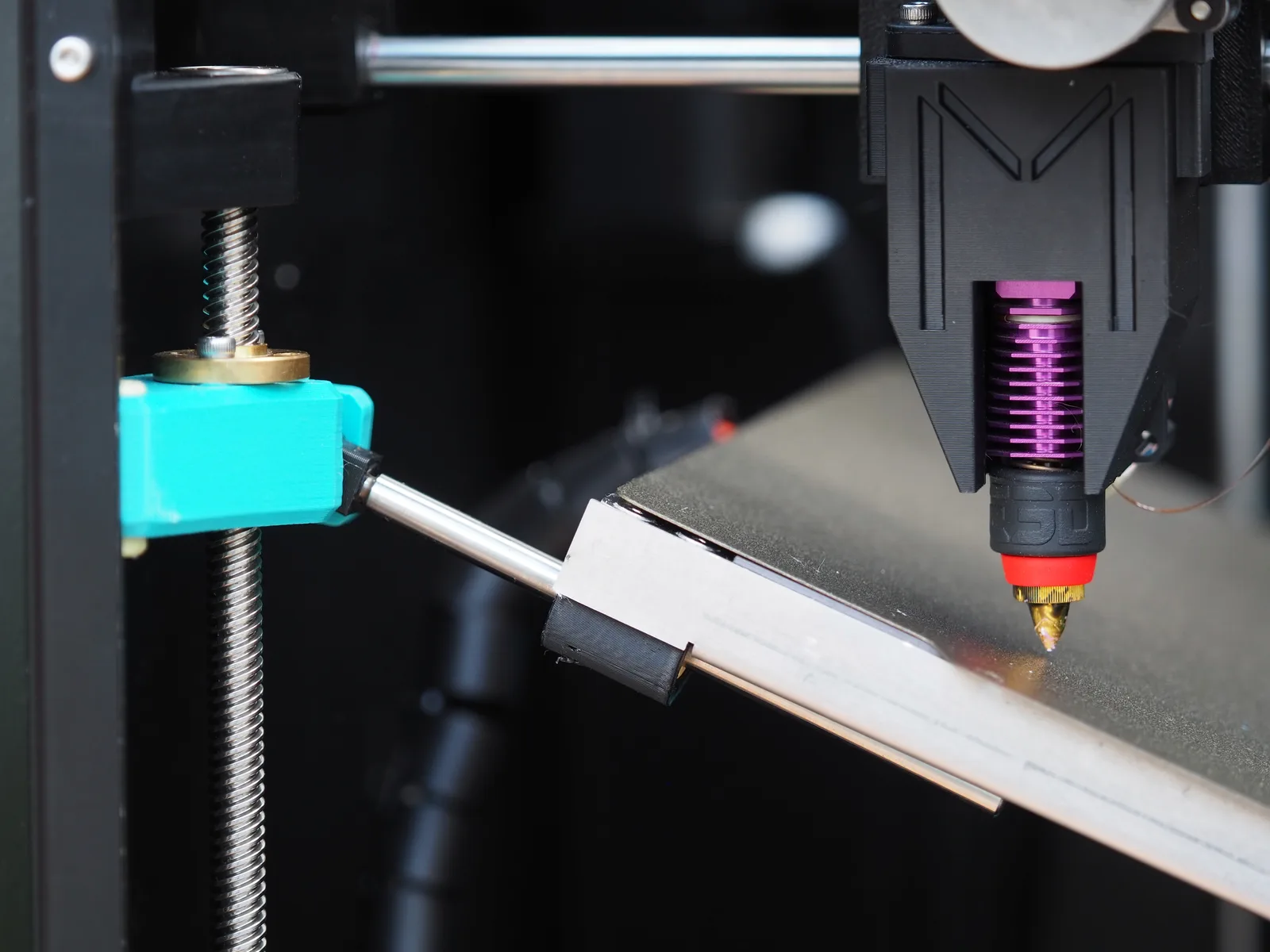
What is non-planar printing?
Understanding the technology
Non-planar 3D printing is an FDM method in which layers are shifted and curved to follow a part's geometry instead of being stacked flat. The Melta MK1 brings this method to your desk as an affordable, consumer-grade non-planar 3D printer.
Standard FDM printers lay layers of plastic flat on top of each other. A non-planar printer shifts and curves these layers to achieve better printing results.
Where a normal 3D printer can't print a specific shape due to its inability to print overhangs, non-planar printers can simply adjust the angle of layers to avoid this issue completely.
Furthermore, more regular FDM printers tend to struggle with layer adhesion, but non-planar 3D printers can create wavy-shaped layers to increase the print strength by up to 62%. [1]
Planar vs non-planar
Flat layers vs layers that follow the part
 02.1 · Planar FDM
Flat layers, stacked
Layers are laid down flat, one on top of another. Overhangs need supports or can't be printed at all, and the flat layer interfaces limit part strength.
02.2 · Non-planar FDM
Layers that follow the part
Layers shift and curve to match the geometry. Overhangs are printed from the side, often with no supports at all, and wavy layers bond more strongly.
Frequently asked questions
Non-planar 3D printing, answered
What is non-planar 3D printing?
Non-planar 3D printing is an FDM printing method in which layers are shifted and curved to follow the part's geometry instead of being stacked flat. It produces stronger parts, saves material and prints shapes that standard planar printers cannot.
Can a consumer 3D printer print non-planar?
Yes. The Melta MK1 is an affordable, consumer-grade non-planar 3D printer. Its tilting bed, custom Klipper firmware and non-planar slicer bring the method to a desktop machine, with no industrial equipment required.
What are the benefits of non-planar 3D printing?
Stronger parts through better layer adhesion, fewer supports and less wasted material on overhangs, smoother surfaces on curved geometry, and shapes that planar FDM printers simply cannot print in one piece.
Do non-planar prints need supports?
Far fewer. Because the print bed tilts up to 45 degrees, overhangs are printed from the side instead of being built up in mid-air. Many angled and curved parts need no supports at all.
How much stronger are non-planar prints?
Wavy non-planar layers increase part strength by up to 62% compared with flat stacked layers, according to a peer-reviewed study of non-planar FDM. [1]
What is the Melta MK1?
The Melta MK1 is an affordable, consumer-grade non-planar 3D printer by Melt3D: a fully enclosed machine with a 45-degree tilting bed, three degrees of freedom, custom Klipper firmware and its own non-planar slicer.
See it in action.
The Melta MK1 puts non-planar printing to work: a tilting bed, custom Klipper firmware and its own non-planar slicer.
Get in touch
Interested in our non-planar 3D printing technology? Have questions or want to collaborate? We'd love to hear from you.